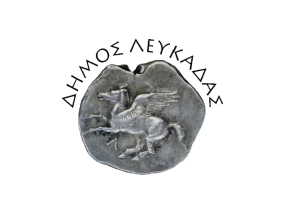
Lefkada takes its name from its white cliffs (lefkos, white) — and from the promontory of Cape Lefkatas in the south, where according to legend the poet Sappho leapt into the sea. In antiquity the island was a Corinthian colony; the canal that separates it from the mainland was first dug by Corinthian settlers in the 7th century BC.
Some scholars, following the archaeologist Wilhelm Dörpfeld, have even argued that Lefkada, not Ithaca, was the Homeric island of Odysseus — a theory still debated with passion on the island.
Centuries of Byzantine, Frankish, Venetian, Ottoman and British rule left the island with a fortress (Agia Mavra), a distinctive earthquake-resistant architecture of timber and corrugated metal, and a cosmopolitan culture. Lefkada joined Greece with the other Ionian Islands in 1864. It is the birthplace of poets Aristotelis Valaoritis and Angelos Sikelianos, and of the writer Lafcadio Hearn.